Leather straps
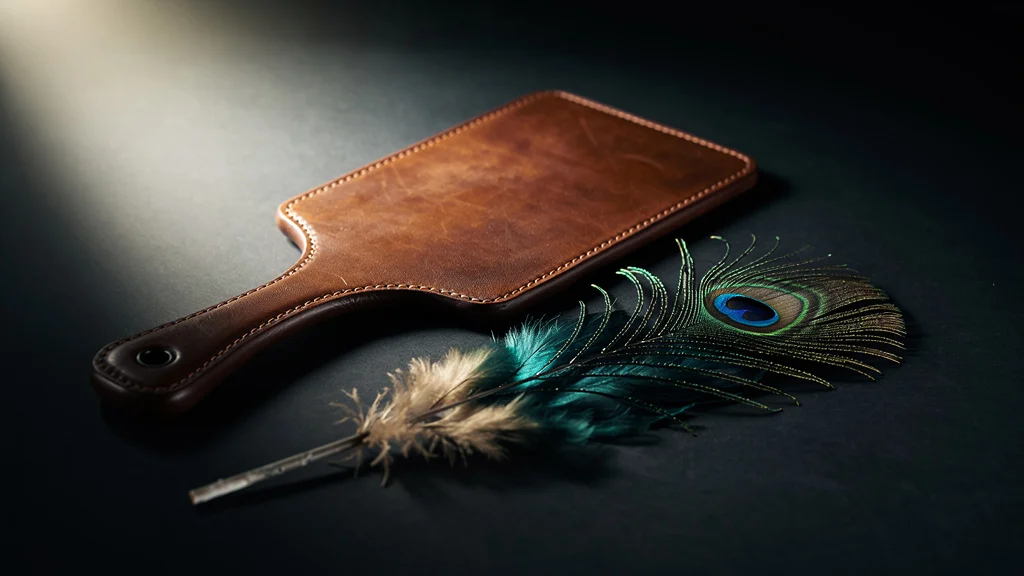
Flat leather straps used for impact, offering a balance between sting and thud sensations. Short Explanation: "Receiving" means you are struck with leather straps; "Giving" means you use them for impact.
Give vs Receive
| Role | What it means for Leather straps activity |
|---|---|
| Receiving | you are struck with leather straps |
| Giving | you use them for impact |
Read the full Yes/No/Maybe list guide or browse all activities.
Interested in exploring Leather straps with your partner?
Start Your ChecklistLeather straps serve multiple purposes in BDSM, functioning as both impact implements and bondage tools. As impact implements, a thick leather strap delivers a distinctive sensation—thuddy and substantial—that differs markedly from the sharp sting of thinner implements. As bondage tools, leather strapping can secure limbs to furniture, create adjustable bindings, and fashion improvised restraints with endless versatility.
The history of leather straps in discipline extends far beyond BDSM, with strapping having been used in institutional and domestic punishment for centuries. This legacy gives leather straps cultural weight and psychological resonance that practitioners may choose to acknowledge or set aside. In modern consensual contexts, straps offer controlled, reproducible sensation that many find satisfying to give and receive.
This guide explores both uses of leather straps—impact play and restraint—covering technique, safety, equipment selection, and integration into scenes. Understanding the properties and proper use of leather straps expands your options for both sensation play and creative bondage solutions.
How Leather Straps Work
Leather straps work differently depending on their intended use. As impact implements, their weight, width, and flexibility determine the sensation produced. As restraints, their length, buckle systems, and attachment points determine functionality.
Techniques and Variations
Impact Use - Swinging: Holding one end of the strap and swinging creates a controlled strike. The weight of leather provides momentum, and the width distributes impact across a larger area than thinner implements.
Impact Use - Folded: Doubling over a strap shortens it and increases impact intensity. This technique is common with longer straps and produces a louder sound.
Impact Use - Wrapping: On curved body parts, straps can wrap around, causing the tip to strike with increased velocity. This is generally undesirable and requires technique adjustment.
Restraint Use - Direct Strapping: Leather straps can bind limbs together or to objects by wrapping and buckling. This is simpler than rope bondage but less adjustable.
Restraint Use - Connector: Straps can connect restraint points—wrist cuffs to ankle cuffs, collars to wrist cuffs, or cuffs to furniture attachment points.
Restraint Use - Hogtie Straps: Specialized straps designed to connect all four limbs in hogtie position, often with adjustable length.
Equipment and Tools
Discipline Straps: Purpose-made impact straps, often with handles and optimal width and weight for impact play. Scottish tawse and prison straps are traditional designs.
Belts: Ordinary leather belts can serve as straps. Remove or control the buckle end to prevent accidental buckle strikes, which can cause injury.
Restraint Straps: Adjustable straps with buckles specifically designed for bondage, available in various lengths with different attachment options.
Utility Strapping: Plain leather strapping by the foot can be cut to custom lengths for specific purposes. Requires adding hardware for functional use.
Safety Considerations
Leather straps require safety awareness for both impact and restraint applications.
Physical Safety - Impact
Target Areas: Safe zones for strap impact include the buttocks (primary target), upper back (avoiding spine), and backs of thighs. Avoid lower back (kidney area), spine, joints, face, and front of body.
Buckle Awareness: If using a belt as a strap, the buckle end must be controlled. A swinging buckle can cause cuts and serious injury. Either hold the buckle end or remove the buckle entirely.
Wrapping Control: The tip of a strap travels faster than the body, so if a strap wraps around a curved body part, the tip strikes with increased force. Learn to control swing trajectory to prevent wrapping or adjust target selection.
Intensity Building: Start lighter than you think necessary. Leather straps can produce more impact than anticipated. Build intensity gradually within each session.
Physical Safety - Restraint
Circulation Monitoring: As with any restraint, check that straps are not impairing blood flow. Tightness may increase as the bound person shifts, requiring periodic adjustment.
Nerve Awareness: Straps across certain areas can compress nerves. Be particularly careful with strapping near wrists, elbows, and behind knees.
Quick Release: Ensure all straps can be quickly released. Avoid configurations where a single strap failure could cause falls or other injury.
Emotional Safety
Historical Associations: Strapping has associations with punishment in schools, prisons, and homes. These associations may produce complex emotional responses. Discuss before incorporating straps into scenes.
Sound Intensity: The sound of a leather strap can be intimidating. Some find this enhances the experience; others find it overwhelming. Consider the role of auditory elements.
Red Flags
Avoid strap play with partners who cannot control where impact lands, refuse to warm up before intense strapping, dismiss feedback about pain levels, or use straps with uncontrolled buckles.
Beginners Guide
Starting with leather straps offers accessible entry points for both impact and restraint interests.
Step 1: Choose Your Purpose
Decide whether you are primarily interested in straps for impact, restraint, or both. This guides your initial purchases and skill development.
Step 2: For Impact - Start with Purpose-Made Tools
A purpose-designed discipline strap with a handle is easier to control than repurposing a belt. The handle provides secure grip and the strap is designed for the intended use.
Step 3: For Impact - Practice Your Swing
Practice on a pillow or cushion before playing with a partner. Learn how the strap moves, where it tends to land, and how to control wrapping.
Step 4: For Restraint - Start Simple
Begin with a single restraint strap connecting wrists or ankles. Learn how to achieve secure but safe tension before attempting complex configurations.
Step 5: Communicate Thoroughly
For impact play, establish feedback systems for intensity. For restraint, establish signals for circulation issues. Both require ongoing communication throughout use.
Step 6: Build Skills Gradually
Master basic applications before advancing. For impact, this means consistent targeting and intensity control. For restraint, this means reliable, safe bindings.
Discussing with Your Partner
Introducing leather straps, whether for impact or restraint, benefits from open discussion about interests and concerns.
For impact play: discuss associations with strapping. Some partners find the disciplinary associations arousing; others may have negative memories of corporal punishment. Acknowledge these possibilities openly.
Discuss sensation preferences. Straps produce different sensations than other impact implements—generally more thuddy than stingy. A partner who enjoys light stingy play might find strap impact too heavy.
For restraint use: discuss how straps compare to other bondage methods in appeal. The rigidity of straps feels different from the flexibility of rope. Some prefer one, some the other, some enjoy variety.
Practical conversations include: who will use the straps (for impact play), what positions and scenarios appeal, and what intensity levels to explore initially.
Frequently Asked Questions
What width of strap is best for impact play?
Wider straps (2-3 inches) produce thuddier, more distributed sensation. Narrower straps (1-1.5 inches) concentrate impact more and can be stingier. For beginners, medium width around 2 inches offers a balanced starting point.
Can I use any belt as a strap?
Theoretically yes, but purpose-made straps are preferable. Belts require careful buckle management to prevent injury. If using a belt, either hold it by the buckle end or remove the buckle entirely. A belt with a secure grip handle added is safest.
How do straps compare to paddles for impact?
Straps are more flexible and wrap around curved body parts more easily than rigid paddles. They produce less concentrated impact than paddles of similar size. The flexibility makes them slightly less predictable for beginners but offers distinct sensation characteristics.
Are leather straps loud?
Yes, leather straps produce significant sound upon impact. This can be a feature or a concern depending on privacy needs. The sound increases psychological intensity for many partners. For noise-sensitive situations, other implements might be more appropriate.
How do I care for leather straps?
Wipe down after use to remove any oils or sweat. Condition periodically with leather conditioner to maintain suppleness and prevent cracking. Store flat or rolled, not folded—repeated folding can create weak points in the leather.
🛒 Recommended Gear
Note: Links below are affiliate links. We may earn a commission at no extra cost to you.
Discover What You Both Desire
Create your personal checklist and compare with your partner to find activities you'll both enjoy exploring together.
Get Started FreeNo credit card required